
Tobacco Use Screening and Cessation Intervention (TSC-E) is built around a simple question. Did we ask the member whether they use tobacco, and when the answer was yes, did we help them do something about it?
For health plans, that question matters because tobacco use remains one of the most significant preventable drivers of disease, avoidable utilization, and long-term healthcare cost. The Centers for Disease Control and Prevention (CDC) reports that in 2024, 9.9% of adults used cigarettes and 7% used e-cigarettes. Among middle and high school students, 8.1% reported current use of any tobacco product in 2024, which represents an estimated 2.25 million students.
New for Healthcare Effectiveness Data and Information Set (HEDIS) Measurement Year (MY) 2026, TSC-E evaluates whether members age 12 and older are routinely screened for commercial tobacco use and whether members who use tobacco receive an appropriate cessation intervention. The measure does not require the member to successfully quit. It evaluates whether members who use tobacco receive a qualifying cessation intervention, such as tobacco cessation counseling, and for adults, appropriate pharmacotherapy.
That distinction is important. TSC-E is not measuring whether a member changes a long-standing behavior overnight. It is measuring whether the health plan, provider network, and care-management programs have a consistent way to identify tobacco-related risk and respond when a member may be ready for support.
The stakes are high. Cigarette smoking harms nearly every organ of the body and contributes to cancer, heart disease, stroke, lung disease, type 2 diabetes, and chronic obstructive pulmonary disease. The CDC estimates that cigarette smoking costs the United States more than $600 billion, including more than $240 billion in healthcare spending and nearly $372 billion in lost productivity.
For health plans, those impacts show up across quality performance, chronic disease management, emergency care, inpatient utilization, and specialty care. Tobacco use can complicate the management of cardiovascular, respiratory, and metabolic conditions, and it can affect outcomes before surgery, during pregnancy, and while managing conditions such as diabetes, asthma, or cardiovascular disease.
That is why member engagement is especially important. Many members do not have regular preventive visits or may need practical help accessing cessation resources. Effective outreach can help members complete the screening, understand why it matters, discuss readiness to quit, connect to support, and follow through on the plan.
This is also a documentation issue. TSC-E is an Electronic Clinical Data Systems (ECDS) measure, which means health plans need structured electronic evidence that the screening occurred, what the member reported and, when applicable, what cessation intervention was provided. A conversation that is not documented in an accessible structured data source may not count toward the measure.
How 86Borders Can Help
86Borders helps health plans move beyond outreach to direct gap closure. Through one-to-one, human care coordination, 86Borders engages members, even those who may be difficult to reach, completes the required screening workflow, discusses tobacco use and readiness to quit, connects members with appropriate cessation counseling and resources, helps address barriers that could prevent follow-through, and remains involved in the next steps.
That support matters because tobacco cessation can be personal. Members may feel judged, discouraged, or uncertain about whether they are ready to quit. A human conversation can meet the member where they are, remove practical barriers, and connect them to support without making the interaction feel punitive or transactional.
Just as importantly, 86Borders closes the loop by capturing the required information and returning documentation and data to the health plan so completed interventions can support quality reporting and gap closure.
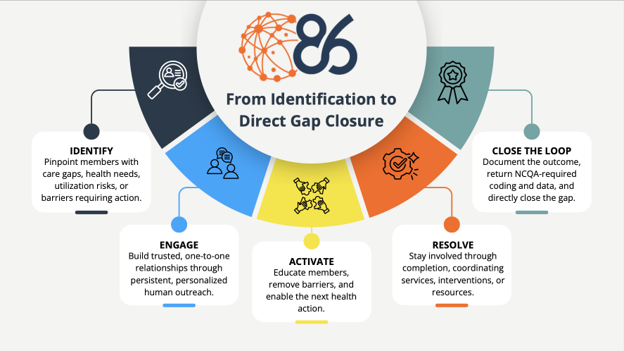
For health plans focused on HEDIS performance, Marketplace Quality Ratings, chronic disease management, utilization, and member experience, TSC-E is an opportunity to deploy a closed-loop system to connect quality strategy with prevention, deliver an appropriate intervention, and capture the evidence.
To learn how 86Borders helps health plans close gaps in care through human-first member engagement and care coordination, contact us today.